
#07 Why perspectives, not takes
How V³ News structures an event differently

In our first piece we made a promise: V³ News tells you why an event matters and whose situation it changes, without pretending to a certainty we don’t have. That’s an easy thing to say. This piece is about how we actually do it.
If you read the intro and thought fine, but show me the machinery, this is for you.
A take is one seat presented as the seat
Most coverage gives you a take. A take is one vantage point, one outlet, one analyst, one set of assumptions, presented as the view of an event. It’s not wrong, exactly. It’s just partial in a way that doesn’t announce itself.
The trouble is that the same event genuinely lands differently depending on where you sit. A central bank holds rates steady. To a bond desk that’s one thing; to a family with a variable mortgage it’s another; to an exporter watching the currency it’s something else again. None of those readings is the “real” one. They’re all real, simultaneously, and a single take quietly picks one and hides the others.
So the first thing we do is separate two things most news fuses together: the event itself, and the perspectives on it.
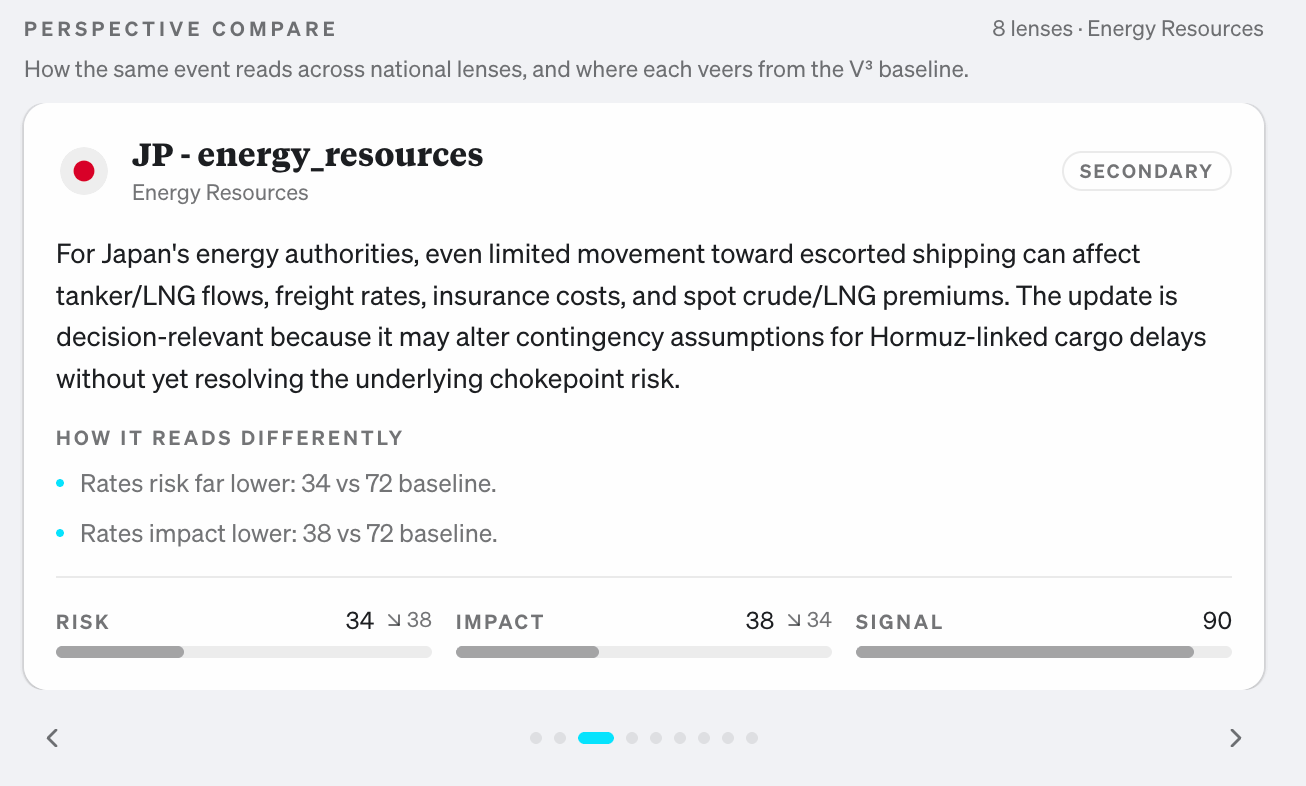
What a perspective actually is
A perspective, in V³ News, is a structured lens on an event, defined by a country, by a category, or by both. It is not an opinion and not an editorial slant. It’s an answer to a specific question: how does this event land when you’re sitting in this seat?
Take that rate decision. The same underlying event carries:
a monetary-policy perspective (what it signals about the path of inflation),
a markets perspective (how it repriced bonds and equities),
and a set of country perspectives (a rate hold means something different to a debtor nation than to a creditor one).
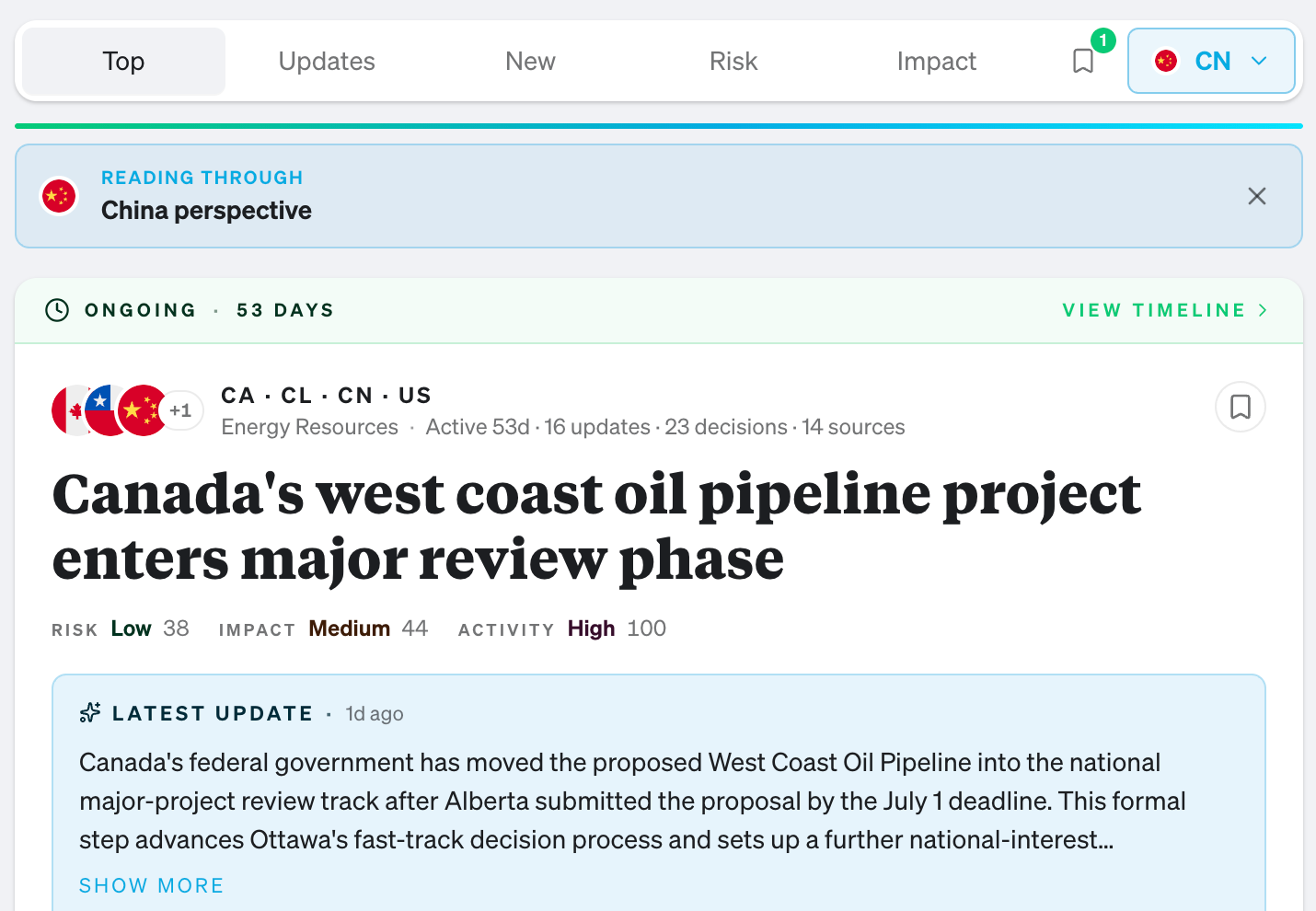
Each is attached to the same event, sourced separately, and scored on its own terms. You’re not reading one writer’s synthesis of all of that, you’re seeing the structure laid out, so you can go straight to the seat you care about.
Scoring: importance, not popularity
Once you’ve separated events from perspectives, you face the harder question: what goes at the top?
The usual answers are recency (newest wins) or popularity (most-clicked wins). Both are proxies for engagement, not importance, and both are why the genuinely consequential story keeps getting buried under the loud one.
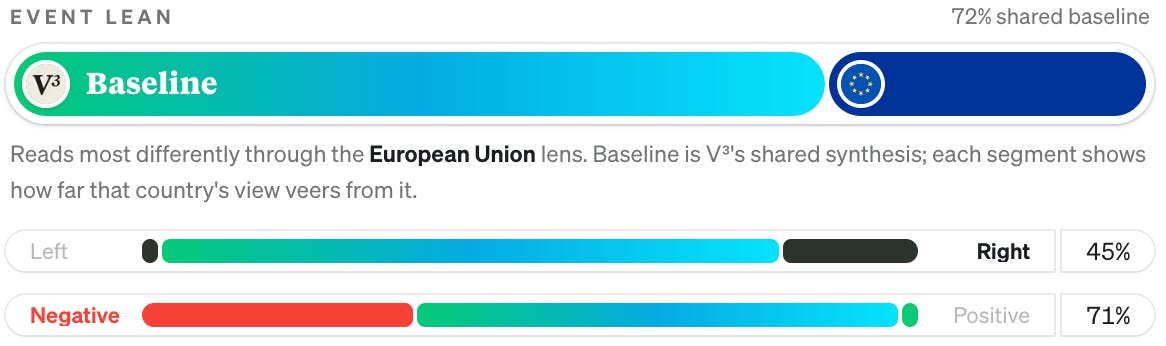
We score instead across what we call signal layers, distinct dimensions of why something might matter. Rather than collapse everything into one “hotness” number, we ask separately: How much risk does this carry? How much impact, and on whom? How much momentum, is this accelerating or fading? An event can be high-impact but low-momentum (a slow structural shift) or low-impact but high-momentum (a fast-moving story that ultimately changes little). Keeping the dimensions apart is what lets importance surface and noise sink, instead of letting the clock or the crowd decide.
Events have a lifecycle
Here’s something article-based news structurally cannot do: track a story as a single thing over time.
An article is a snapshot. It’s true the moment it’s published and then it’s frozen, while the world keeps moving. Forty more articles get written, each a fresh snapshot, and the through-line, the story, lives only in your head, if you managed to read all forty.
In V³ News an event is a living record. It has a lifecycle: it’s active while developing, drops to monitoring as it cools, and can be superseded when a newer event overtakes it, or reactivate when it flares back up. Its scores decay over time unless fresh developments refresh them, so the front page doesn’t clog with last month’s news still shouting at this month’s volume. A story that has run for six weeks shows you its arc, not forty disconnected snapshots.
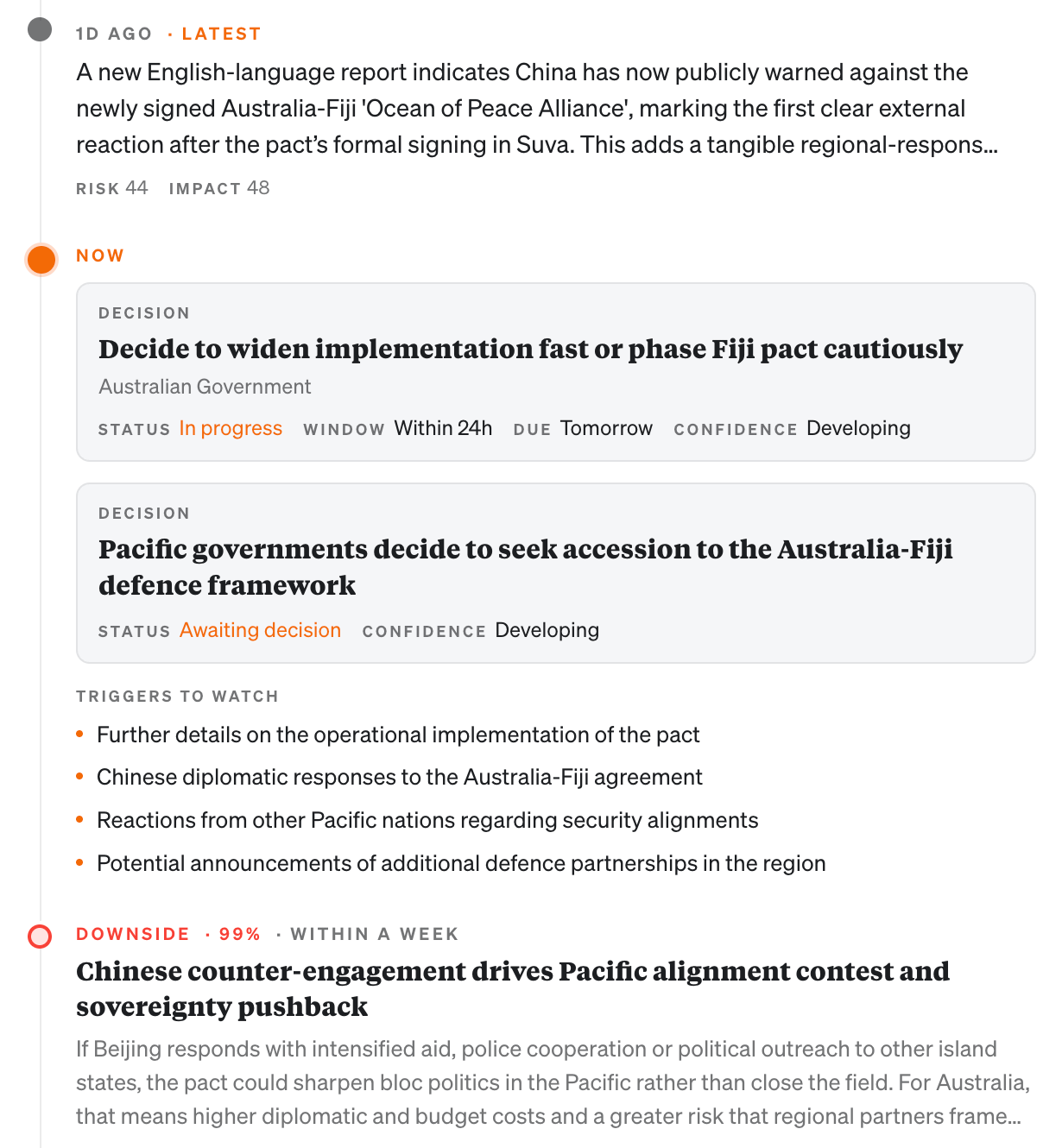
One event, not forty
This is the piece people ask about most, so briefly, the mechanics.
When a major story breaks, dozens of outlets cover it. Naively ingesting that gives you dozens of near-identical records, exactly the volume-drowns-meaning problem we’re trying to kill. So before anything is published, we deduplicate against the existing corpus: candidate events are matched on title similarity and on overlap of the named entities involved (the people, organisations, places, and instruments in the story). Matches collapse into a single event with its sources consolidated underneath.
The result is the thing you actually wanted all along: one clear event, many sources, no repetition.
Why this matters if you have to act on it
Put those four pieces together, perspectives, signal-layer scoring, lifecycle and decay, deduplication, and you get something different in kind from a stream of articles. You get a structured, scored, multi-seat, time-aware record of what’s happening.
If you read the news for interest, that’s simply calmer and clearer. But if you read it because you have to do something, allocate, advise, decide, brief someone above you, it’s the difference between raw material and something you can actually work from. A take tells you what one person thought. A structured event tells you what happened, how confident we are, who it moves, and where it’s heading.
That’s what we mean by perspectives, not takes.
See it on a live event. And if you build things, researchers, analysts, developers, structured access to this data is on the roadmap; we’d like to hear what you’d do with it.
This essay was drafted with AI and reviewed by humans before publishing. We use the tools available to us, and a human reads every word that goes out.