
#06 Informed, Global Awareness
Why we built V³ News

I owe a proper update on the Chaos, and I have a backlog of other articles drafted; however, I will save that for another post. For now, I am going to introduce another project that aims to provide global awareness without the entertainment and agendas.
You know the feeling. You pick up your phone to “check the news,” and twenty minutes later you put it down again, tighter in the chest, no clearer in the head. You scrolled through a war, a market move, a celebrity feud, three things designed to make you angry, and one genuinely important story buried somewhere in the middle that you’ll never find again. If someone asked you what you actually learned, you’d struggle to answer.
That’s not a personal failing. It’s the design working as intended.
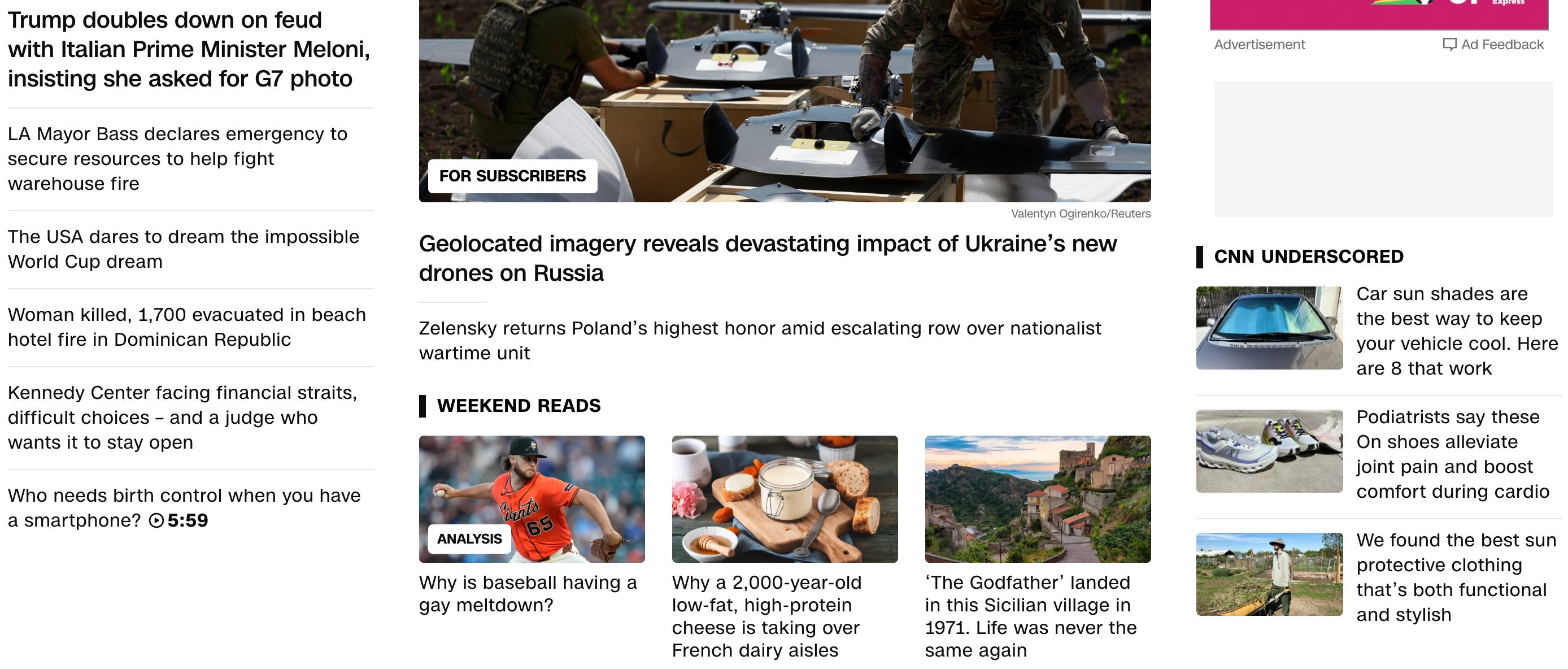
Most of what we call “the news” today isn’t built to inform you. It’s built to hold you. The feed is optimized for time-on-screen, and the things that keep you on screen, outrage, novelty, the endless next thing, are not the same as the things that help you understand the world. The product is doing exactly what it was made to do. It just wasn’t made for you.
What’s actually broken
When you look closely, the problem isn’t a lack of news. It’s three failures stacked on top of each other.
Volume drowns meaning. A single story breaks and forty outlets publish forty versions of it within the hour. You don’t get forty angles, you get the same thing forty times, each one fighting for the same slice of your attention. Repetition wearing the costume of coverage.
Recency beats importance. The newest thing wins, every time, regardless of whether it matters. A genuinely consequential development from this morning gets shoved off the screen by something louder from this afternoon. The clock decides what’s important, and the clock is a terrible editor.
One seat, one view. Most coverage gives you a single framing and presents it as the framing. But the same event lands completely differently depending on where you’re sitting, which country, which industry, which set of concerns you’re carrying. You rarely get to see that. You get one view, full stop, and you’re left to guess at the rest.
None of these are fixable by reading more. Reading more is the trap.
What if news were built differently
Here’s the conviction we started from: your view of what’s happening should be structured, it should be balanced across the whole world, not just the one or two topics that happen to generate outrage, and it should be honest about what it doesn’t know.
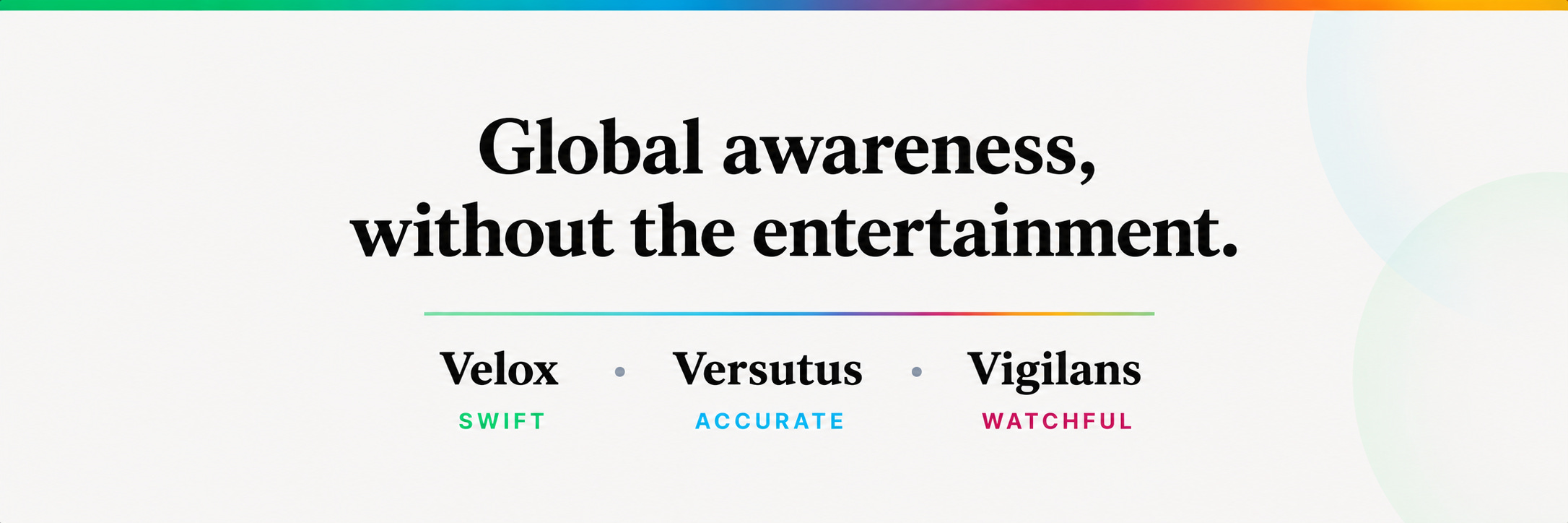
Those three ideas have a shape. We named it after an old motto, Velox, Versutus, Vigilans: swift, accurate, watchful. Get the signal first. Get it right. Keep watching after everyone else has moved on. Not as a slogan, but as a standard to hold ourselves to.
So we built it.
What we built
V³ News is a calmer, more structured read of what actually matters today, across twelve categories, not just one.
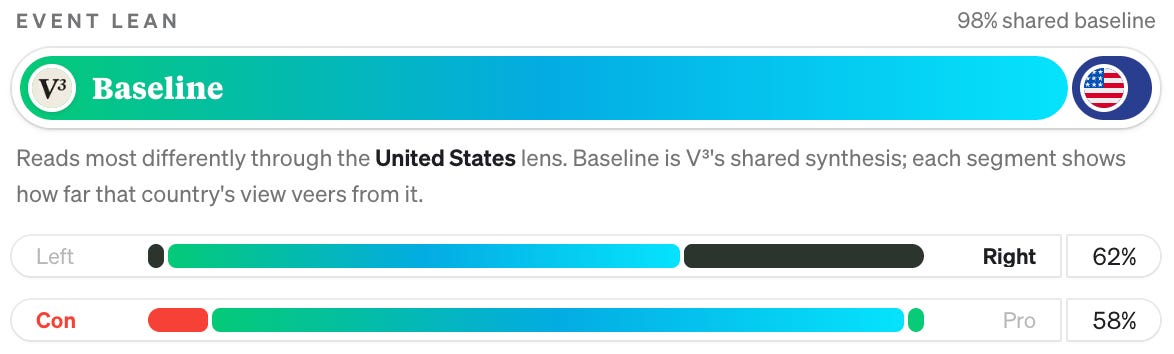
Instead of a stream of articles, you get events. When something happens, we pull together everything written about it and construct a single, clear picture: what happened, why it matters, and whose situation it changes. When forty outlets cover the same story, you see one event with its sources consolidated underneath, not forty cards competing for your scroll.
We tell you, in plain language, why each event is worth your attention. We show you how it looks from more than one seat. And we don’t pretend to certainty we don’t have, where the picture is still forming, we say so.
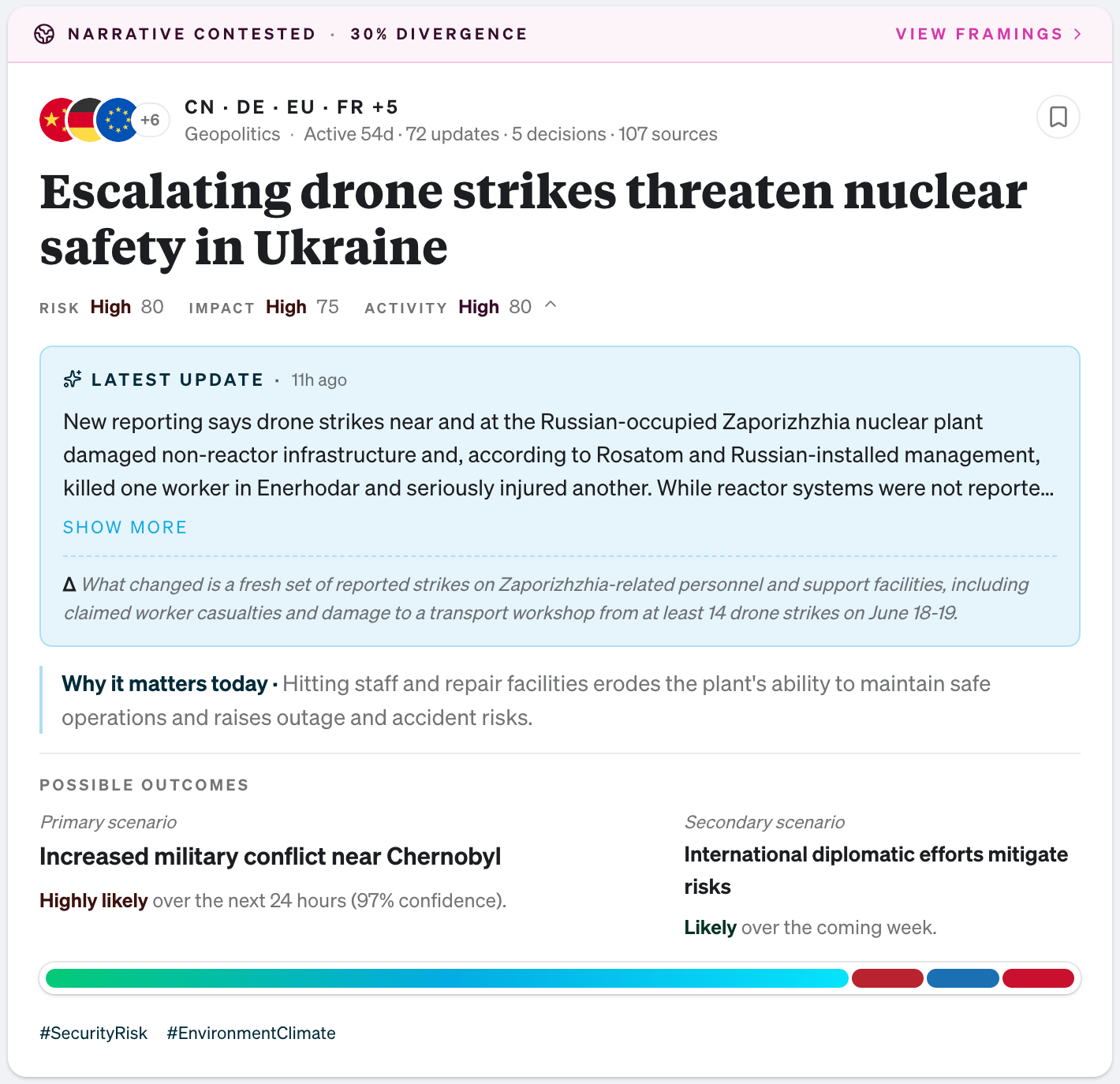
Behind every event we keep what we call a V³ Baseline: a synthesis that holds the major perspectives in tension rather than collapsing them into one. Geographic, political, and sentiment leanings are scored explicitly, and where the coverage tilts heavily one way, we say so out loud. When the picture has visible holes, we deploy field agents 🕵️, automated researchers that go looking for the perspectives we don’t yet have. The baseline keeps widening instead of locking around whatever happened to land in our inbox first.
For the curious, there’s a lot more underneath: how we score what matters, how we track a story as it evolves and fades, how the whole thing is put together. (If that’s you, start here.) But you don’t need any of it to get the value. The point is simply this: you should be able to spend less time and come away knowing more.
“Isn’t this a geopolitics thing?”
Not really, and this matters, so let me be clear about it.
Right now, if you look at V³ News, you’ll see a lot of geopolitics. That’s not the plan; it’s where the data happens to lean today. Geopolitics is one of twelve categories, alongside technology, business, science, culture, and the rest of the world you actually live in. The goal was never a single beat. It’s a balanced view of everything that’s moving, so you’re not just well-read about one corner of the world and blind to the rest.
We’re consistent fine-tuning and widening the lens as fast as we responsibly can.
We’re early, and that’s the honest part
This is the beginning. Coverage is uneven. Some categories are richer than others, geopolitics is overweighted today, and we’ll get things wrong as we grow. We are only covering 40-50 countries at the moment, and are adding more regularly as we continue to learn. We’d rather tell you that plainly than dress it up.
But the foundation is built, the thing works, and it’s live right now. If you’re tired of finishing the news more anxious and no wiser, come take a look. See what we’re building at v3.news, and if you’d like a single calm read each morning instead of the scroll, subscribe to the daily brief.
That’s the whole idea. A calmer, clearer view of what’s actually happening. We’d love your company while we build it.
This article was drafted with AI 🤖 and reviewed by humans 🧍🧍♀️ before publishing. We use the tools available to us to impact to help make for a better tomorrow. #AIForGood
Find us: v3.news · Bluesky · X · Threads · Instagram
Download: Apple App Store | Google Play Store