
#04 0Pro: Part 1
A Pain in My...

Friday, September 5th, 10:45 a.m. was the time I casually blocked off to do a round-table review of project management tools, with the intent of picking one to implement with Tribe.
I’ve used and have been charged with rolling out Jira, Shortcut, Monday.com, Asana, Trello, Basecamp, Notion, Slack, spreadsheets, Airtable, and more. The common theme every time is maintaining company-wide buyin over a sustained period of time.
While I’ve long held a low regard for these tools, my breaking point came when reviewing the new kid on the block, Linear, the new “hype” tool everyone is using. How this new tool broke me was, admittedly, a nuanced detail: their decision to call all work units “issues.” I did some digging to see if I could change this in the configuration settings… rename it to “tasks,” “items,” “work,” anything other than “issues.” No bueno.
So what’s my issue with “issues”? For me, it’s the psychological and cultural impact. Deep down, I don’t want my teams thinking of their work as “issues”, or as problems to be fixed. We should be building, innovating, and delivering value, not “fixing issues.” Imagine developers working all day on issues, and business teams checking in on the status of those issues. Over time, that kind of language surely causes… well, issues. Overly sensitive, perhaps.
That afternoon, after more than a decade of complaining about these tools, I decided I was finally going to do something about it.
How? By creating yet another to-do tool. Genius idea. 💡
History, Context, and Why Me
Over the past decade working with startups, I have generally been the lone technical senior leader/founder, and often was delegated company processes in secondary operations or chief of staff roles.
Some lessons learned (generalized):
Non-technical founders often have anxiety about what product/dev is doing,
Business teams have no interest (time) to dig around product tools,
Developers don’t need to be involved in strategy, but want the opportunity to be,
There is a high likelihood quarterly OKR’s will be blown up one week into the quarter,
Departments often feel mis-represented during product prioritization exercises,
Everyone wants more data, then rarely use it, and
It is rarely the tools fault, but the tools don’t exactly help either.
Fun facts: The average founder age for Jira, Asana, and Notion was 24 years old. Almost all startup tools were founded by software engineers ~ 🤔
For non-technical founders, product owners, and business staff this should be enlightening as to why the tools always feel so foreign, they were never designed for you.
What those 24-year-old software-engineer founders did not have, was over a decade in government project management, two decades of needing to get things done under pressure (military), and another decade in startups bridging the gap between tech and business. Add to that, years spent working alongside some very bright scientists to develop and roll out role-based Information Management (IM) systems across the entire Army, more on this in a follow up post.
<ENTER> Project: 0Pro
That weekend, after my fateful Linear meltdown, I worked relentlessly with my AI agents to document, and re-document, the many pain points, experiences, and half-solutions I’ve gathered over the years. Out of that process came a methodology and a set of principles that I began building into a system during evenings and weekends.
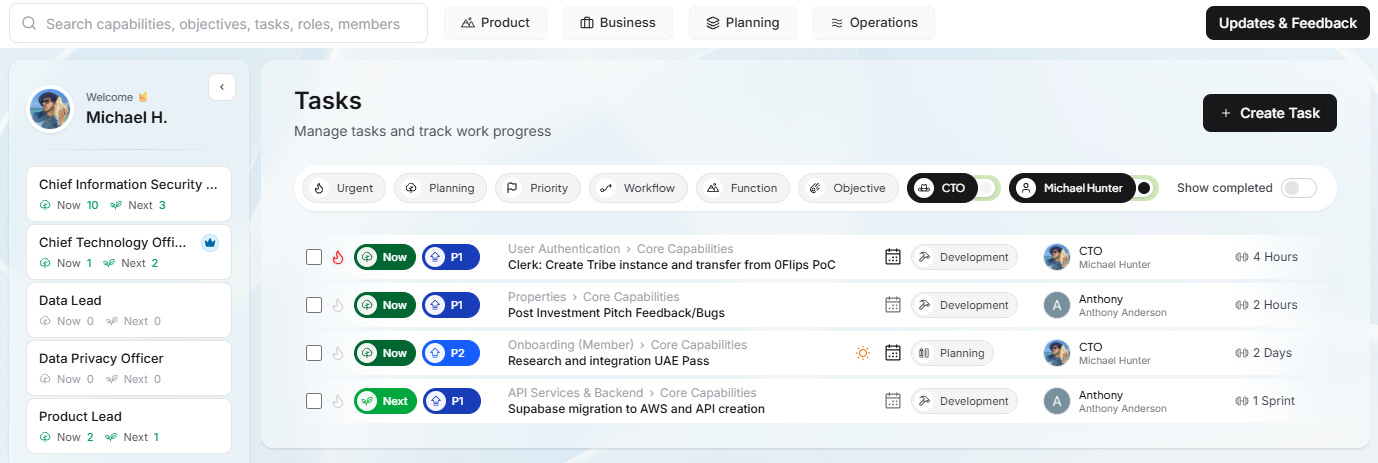
A month later, I pushed the half-built boat into the water. I’m now onboarding my active projects/teams so I can learn and iterate in real-time. The tech team has rallied around using it to manage our daily Now, Next, Later work. There is daily AI summarization to provide business with awareness, initial prioritization to start the milestone planning process, and will be releasing the business team experience and milestone planning in the next few weeks to onboard the non-tech team ~ the real test.
While the Alpha (0Pro.ai) is technically live, the onboarding education layer is still required to right-size the experience and introduce concepts ahead of looking for friendlies to start testing. In the meantime, you can get a snapshot of 0Pro’s principles on the landing page. Stay tuned for Part 2, where I’ll dive deeper into the principles themselves and explore how 0Pro could serve as a foundation for agentic collaboration within organizations — and, in a likely third post, how this could evolve into a fairer, more efficient approach to performance management and hiring processes.
Closing Note
No disrespect to the young, software-engineer founders! I actually believe that with AI it is them who should be even more empowered to automate and simplify “business” so they can build more 😁